› Korean War Surplus and M1951 Gear › Forceps, Hemostatic, Straight Kelly
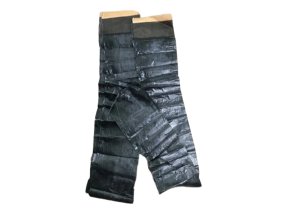
Originally packaged straight pean Forceps, Hemostatic, Straight Kelly. 1950s production.
Complete experimental pouch EX 54-1. Very nice condition.
Ultra-rare US Army Tanker Helmet type QM1C (1950s). Made by Riddell. Hard-to-find Size 7 3/4 (XL). Much rarer than M1938 helmets. Korean War era.
A museum-quality collector's set featuring experimental/prototype Shoulder Sleeve Insignia (SSI) designs for the 10th Mountain Division. Dating back to the division's reactivation as a Training Division at Fort Riley during the Korean War era (1948–1954), these specific designs and color variations were tested but never officially adopted for mass issue.
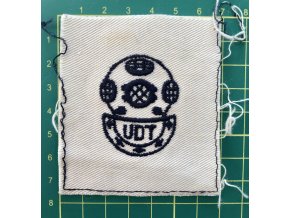
An extremely rare original patch of the UDT (Underwater Demolition Teams) dating to the Korean War era. These elite "Frogmen" (often nicknamed "The Naked Warriors") were responsible for hydrographic reconnaissance and beach clearance ahead of amphibious landings like Inchon. These units are the direct lineage of the modern US Navy SEALs.
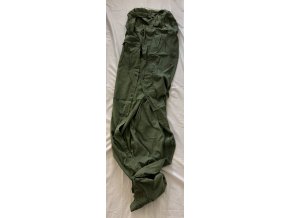
Nepoužitá zimní vložka do kalhot M51. Značeno USMC. Velikost M-L.
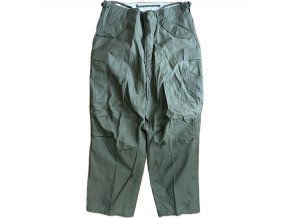
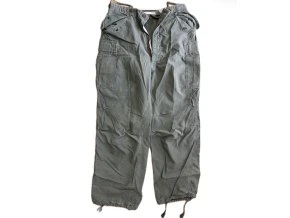
Nepoužité kalhoty M51 Arctic. Velikost M-R, vložka S-L. Rok výroby 1951.
M9A1 gas mask with bag, filter and cleaning cloths. Stock condition - including cardboard insert and wrapping paper. Size M.
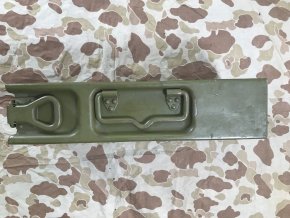
Ammunition box for ammunition and bandoliers for M1 Garand rifle.
USMC duffel bag from WW II. The bag is signed G. M. Pfeiffer, 647210 Sgt. Very nice condition.
Authentic World War II "Mosquito Bar" – the large box-shaped net designed to be suspended over a folding field cot. Made entirely of the iconic Frogskin (Duck Hunter) camouflage netting. This item is in New Old Stock (NOS)condition. A stunning centerpiece for any USMC Pacific campsite display or a source of pristine original camo material.
The ultimate piece of USMC airborne gear: Original WWII Drop Bag / Jump Scabbard for the M55 Reising Submachine Gun. Issued exclusively to the legendary Paramarines. Made of heavy canvas in the Frogskin camouflage pattern. This item is in used condition showing honest wear, yet remains structurally perfect without any damage(rips, tears, or missing hardware).
A highly collectible WWII artifact: An original Lucky Strike "Green" Flat Fifty Cigarette Tin. The green packaging is iconic, as the company famously switched to white in 1942, making this a rare pre-war or early-war production piece. This specific tin was found in Normandy, linking it directly to the European Theater of Operations. While the exterior shows "salty" rust and wear consistent with a battlefield relic, the interior remains surprisingly legible with the classic "It's Toasted" slogan and Indian head logo. Dimensions: 11cm x 14cm.
WWII US Army North African Theater of Operation Patch
A hard-to-find pair of 1st Pattern M1941 HBT Trousers. Distinguished by the internal front and rear pockets (no large cargo pockets like the 2nd pattern). Stamped size 32 x 31. While the fabric is structurally excellent and durable, the trousers feature significant authentic oil staining and grime throughout. This "salty" patina makes them absolutely perfect for a Motor Pool, Tanker, or Mechanic impression, where pristine gear would look out of place.
A guaranteed original World War II era shoulder sleeve insignia for the 17th Airborne Division ("Golden Talon"). This is a two-piece set featuring the division patch and the separate AIRBORNE tab, which is historically correct for the era. Authenticity is confirmed by the UV light test (does not glow), indicating vintage cotton construction suitable for the 1940s. The reverse features the desirable "Snowy Back" embroidery.
Used pocket guide A Guide To U.S. Army Insignia. Year of publication 1941.
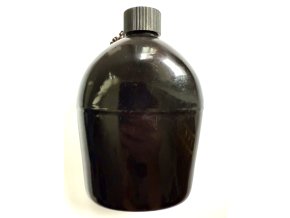
An American experimental World War II etocellulose canteen, dated 1943 and marked AICO.
In an attempt to produce a non-metallic canteen during World War II, the U.S. government attempted to produce a plastic canteen using Dow Chemical's etocellulose plastic. The canteen was manufactured by several government contractors, including AICO. Production of the canteens began in mid-1942 and production ceased in 1944.
Canteens were usually issued to troops in the Pacific. This canteen was commonly found in USMC units. The problem with the canteens was that they had a tendency to crack over time due to heat exposure. Also, the water they contained took on a bitter taste. To remove the aftertaste, soldiers commonly added baking soda to the water when filling the canteen.
AICO produced only 4,400 of these canteens.
A scarce and highly desirable original WWII shoulder sleeve insignia of the Merrill's Marauders (5307th Composite Unit Provisional). Famous for their long-range penetration missions behind Japanese lines in the Burma theater. This patch features the correct WWII "Cut Edge" construction. Authenticity verified: The threads do not glow under UV light, confirming the use of vintage cotton materials rather than modern synthetics.
Be the first who will post an article to this item!
Only registered users can submit posts. Please log in or sign up.
Settings